
Ham Radio Tools
Antenna Length Calculator
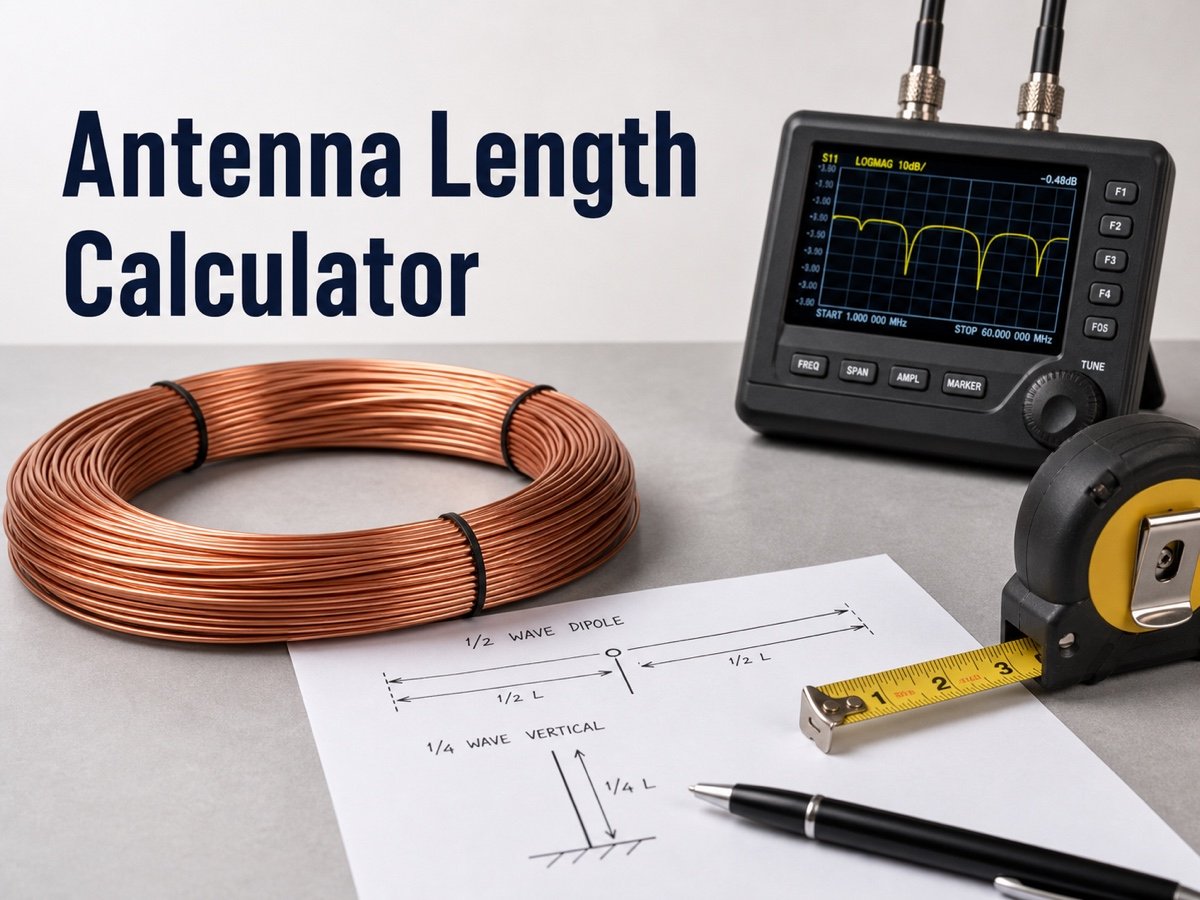
Estimate starting lengths for common ham radio antennas from frequency. Calculate half-wave dipoles, quarter-wave verticals, full-wave loops, end-fed half-wave wires, 5/8-wave verticals, and custom wavelength fractions in feet and meters.
Calculator
Results
Enter values to estimate antenna wire length.
| Band | Frequency | Total length | Each side / element | Wavelength |
|---|
How the Calculation Works
The calculator starts with free-space wavelength, chooses the requested fraction of a wavelength, then applies a practical correction factor. Dipoles and verticals usually start shorter than free-space length because of end effect. Full-wave loop choices use the same starting total wire length, then divide it into square, delta, rectangular, or skywire-style dimensions.
Rules of Thumb
- Half-wave dipole total length is commonly estimated as 468 / frequency_MHz in feet.
- Each dipole leg is half of the total dipole length.
- Quarter-wave verticals and radials are commonly estimated as 234 / frequency_MHz in feet.
- Full-wave loop total wire length often starts around 1005 / frequency_MHz in feet, whether the loop is square, delta, rectangular, or an irregular skywire.
- For insulated wire, low height, or nearby objects, expect the final trimmed length to differ from the calculator result.
Trimming and Tuning
Treat these numbers as starting lengths, not final construction dimensions. Build the antenna a little long, install it near its final height and surroundings, then measure resonance with an antenna analyzer or VNA. Trim both dipole legs evenly. For verticals, tune the radiator first and adjust radials only when the design calls for it.
If the antenna resonates too low in frequency, it is usually too long. If it resonates too high, it is usually too short. Make small changes, remeasure, and keep notes.
For loop antennas, the total wire length is the loop perimeter. A delta loop divides that total into three sides, a square loop into four sides, a 2:1 rectangle estimates long and short sides, and a skywire or irregular loop mainly uses the total wire length because support spacing determines the final shape.