
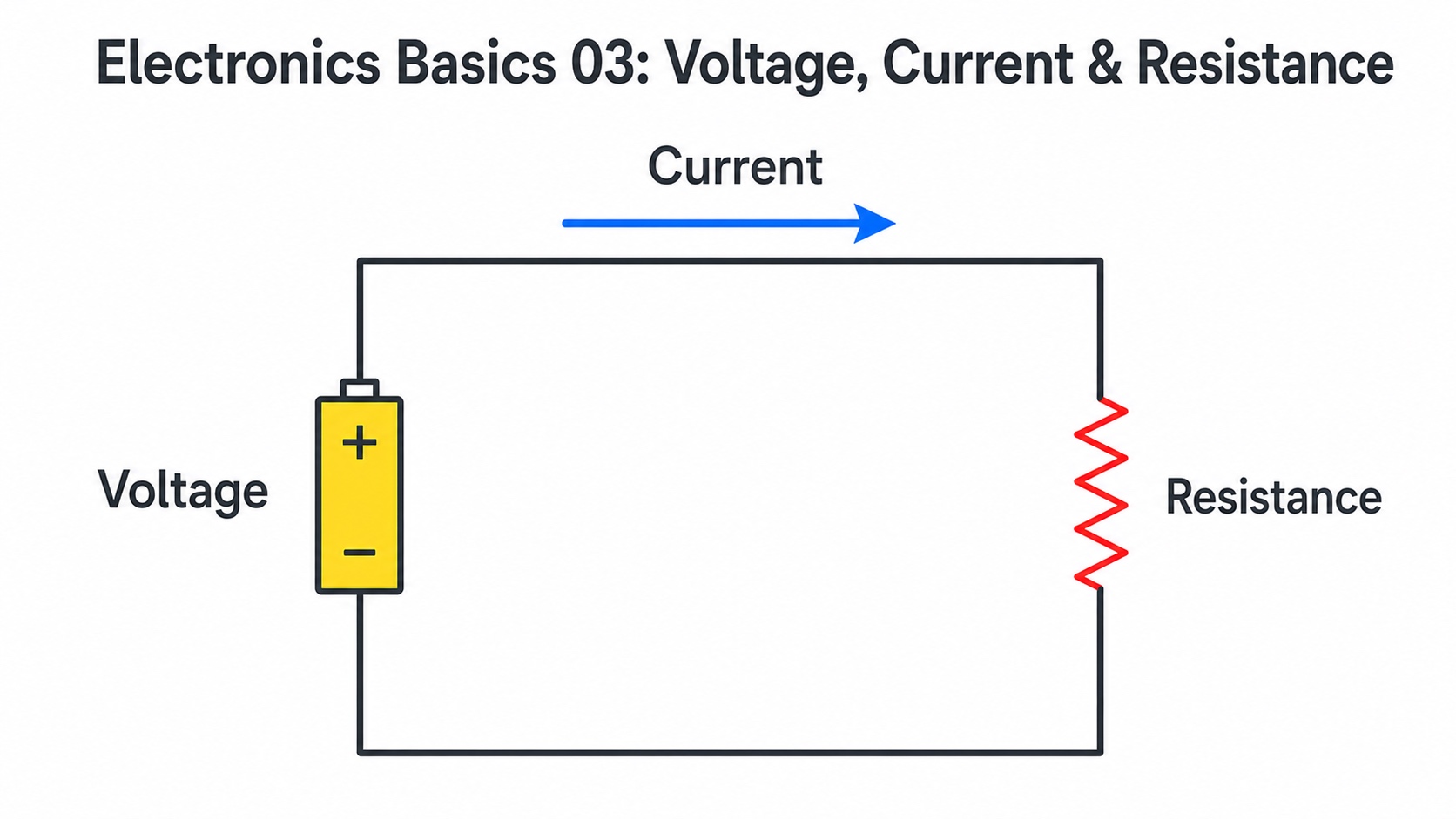
Welcome back to our Electronics Basics series. In the first two lessons, we learned about electrons, electric charge, static charge, and electric current. Now we will explore three fundamental electrical quantities—voltage, current, and resistance—and see how they work together.
We will use a water-pipe analogy to make the ideas easier to visualize. Like any analogy, it is not perfect, but it is a useful starting point for understanding simple circuits.
1. Current: The Flow of Electric Charge
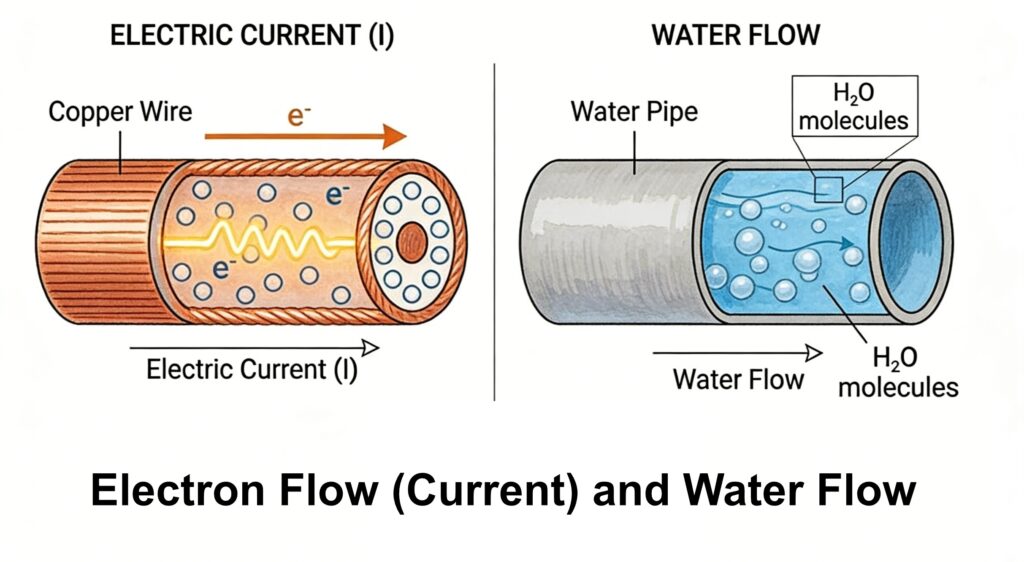
Electric current (symbol: I)** is the rate at which electric charge passes a point. It is measured in amperes (A), often shortened to “amps.” One ampere equals one coulomb of charge per second, and one milliampere (mA) equals 0.001 A.
In a metal wire, the moving charge carriers are electrons. In other materials, current may be carried by positive ions, negative ions, or both, so current is more accurately described as the flow of charge, not only the flow of electrons.
The water analogy is straightforward: electric current is like the rate of water flow through a pipe. A larger amount of water passing a point each second corresponds to a larger current.
2. Voltage: The Difference That Drives Charge
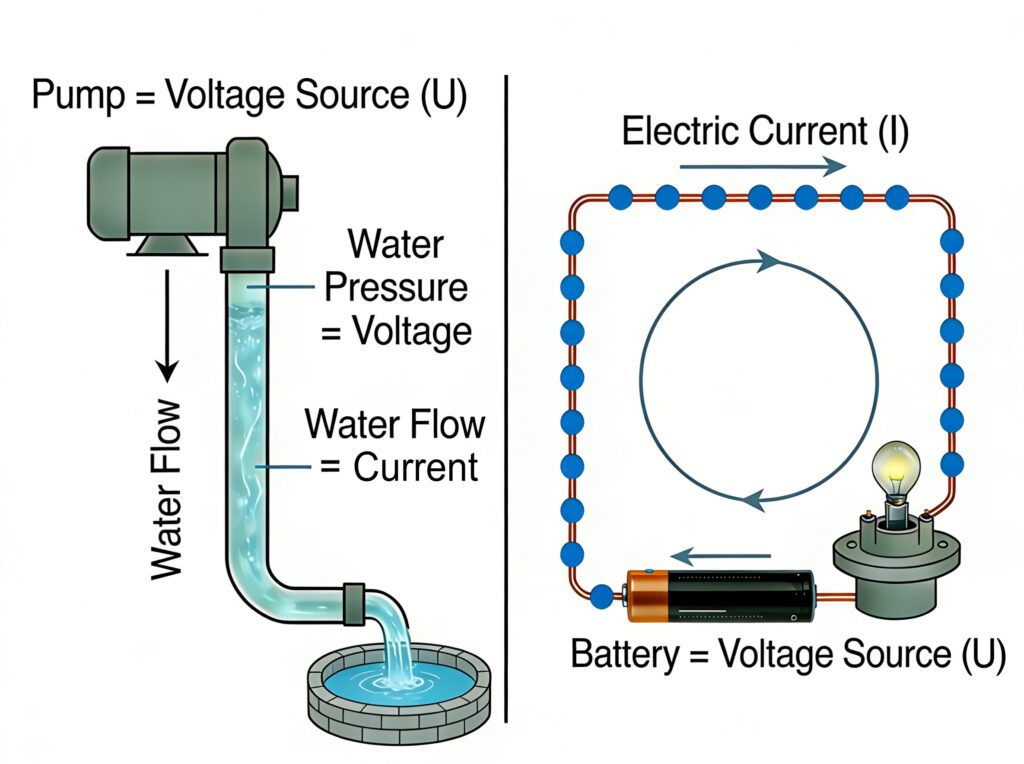
Voltage, also called electric potential difference, describes the difference in electric potential between two points. It is measured in volts (V). English-language circuit diagrams commonly use V as the voltage symbol; U is also widely used in IEC and European notation and appears in the figures in this article.
Voltage is similar to a pressure difference in a water system. A pump creates a pressure difference that can drive water through a connected pipe. In a circuit, a battery or power supply establishes a potential difference. When there is a complete conducting path, the resulting electric field causes charge to move.
A 1.5 V cell can power a device designed for that voltage. A 9 V battery provides a larger potential difference, but it is not automatically “more powerful”: the current and power also depend on the connected load and its resistance.
Without a potential difference across a passive component, there is no steady current through it. A complete circuit is also necessary; an open switch stops the continuous flow even when a battery still has voltage across its terminals.
3. Resistance: Opposition to Current
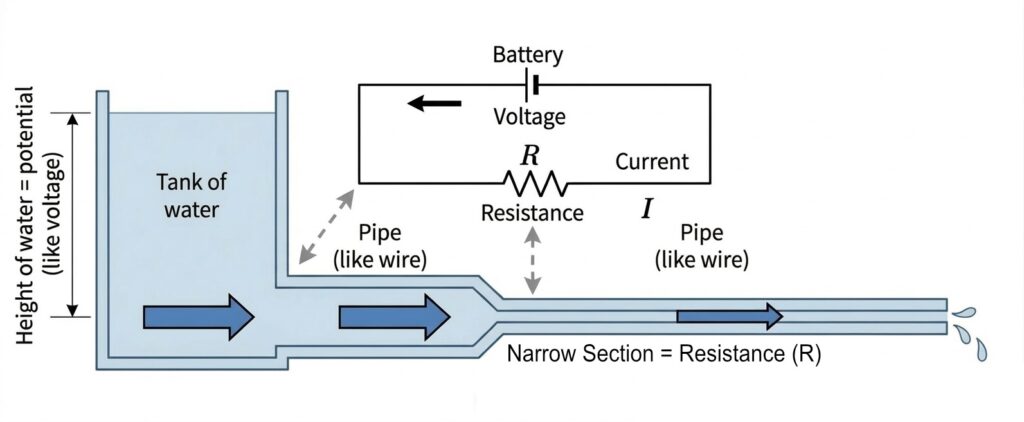
Resistance (symbol: R) describes how strongly a component or material opposes electric current. It is measured in ohms (Ω).
In the water analogy, a long, thin, rough, or partially blocked pipe presents more hydraulic resistance than a short, wide, smooth pipe. For the same pressure difference, greater hydraulic resistance reduces the total flow rate. A narrow section does not necessarily make the water move more slowly at that exact point; its local speed can increase. The useful comparison is that the restriction raises the system’s resistance and reduces the overall flow for a fixed pressure difference.
Electrical resistance similarly limits the rate of charge flow for a given voltage. A wire has some resistance, although it is often treated as negligible in simple circuit diagrams. Resistors are components made to provide a controlled amount of resistance.
Insulators such as plastic and rubber have very high resistance under normal conditions. Wire insulation prevents significant current from taking an unwanted path to nearby conductors or a person. Conductors such as copper have much lower resistance and allow charge to move more readily.
In an incandescent flashlight, the filament is a resistive load that heats until it glows. In an LED flashlight, current is normally limited by a resistor, an electronic driver, the battery’s internal resistance, or some combination of these. Connecting a low-resistance path directly across a battery creates a short circuit and can produce dangerously high current.
4. How Voltage, Current, and Resistance Work Together
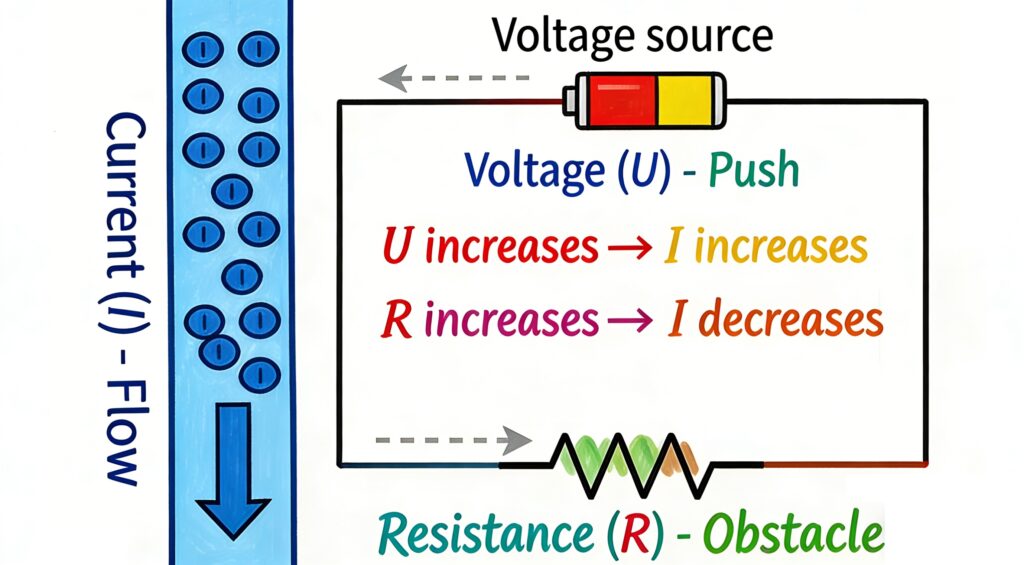
For an ohmic component whose resistance remains approximately constant, voltage, current, and resistance are related by Ohm’s law:
V = I × R
The same relationship can be written as I = V / R. It gives three useful rules:
- When voltage increases, current increases if resistance stays constant.
- When resistance increases, current decreases if voltage stays constant.
- When resistance decreases, current increases if voltage stays constant.
Not every device behaves like a fixed resistor. LEDs, batteries, motors, and many electronic components are non-ohmic or change resistance as their temperature or operating conditions change. Ohm’s law is still essential, but the simple proportional rules apply most directly to resistive components under stable conditions.
5. Everyday Examples
- Flashlight: The battery supplies voltage, and a closed circuit allows current to flow. An incandescent filament provides resistance and converts electrical energy into heat and light. An LED flashlight uses current-limiting circuitry so the LED operates safely.
- Phone charger: A charger converts mains AC into regulated, low-voltage DC. Its switching electronics, feedback circuitry, and charging protocol regulate the output; current control is not performed by a simple series resistor alone.
- Hair dryer: The mains supply provides voltage across a heating element and a fan motor. Current through the resistive heating element converts electrical energy into heat, while the motor moves air across it. The current depends on the appliance’s power rating and the local supply voltage.
6. Key Differences
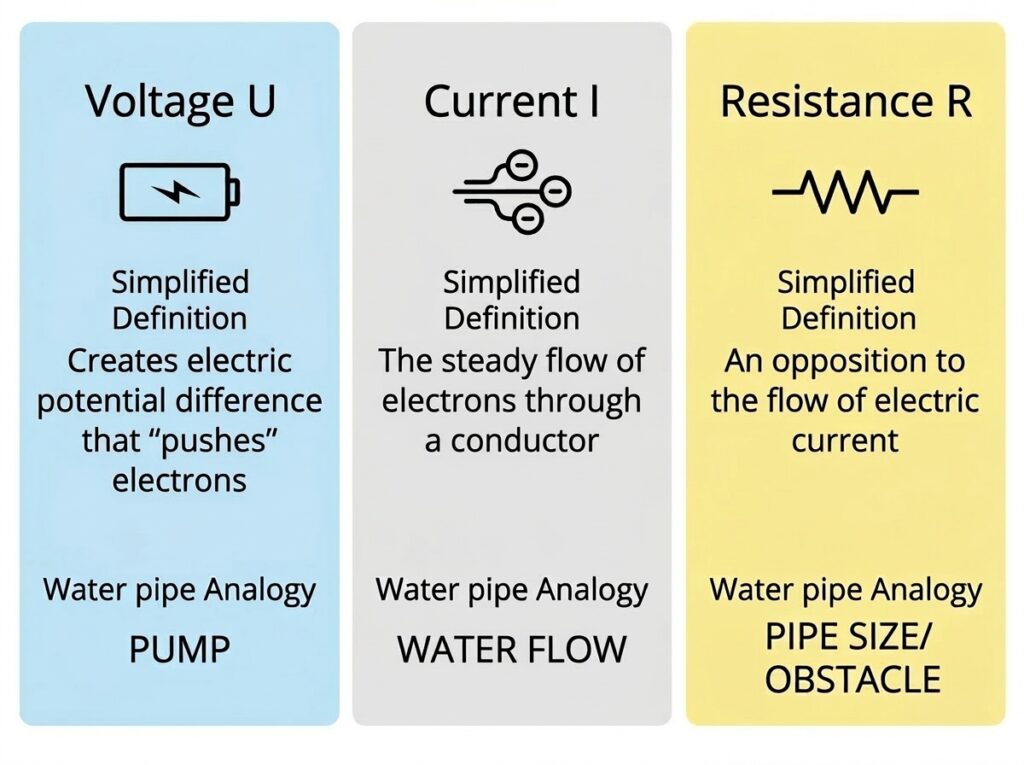
| Concept | What it means | Water-system analogy | SI unit |
|---|---|---|---|
| Voltage (V or U) | Electric potential difference between two points | Pressure difference | volt (V) |
| Current (I) | Rate of electric charge flow | Volume flow rate | ampere (A) |
| Resistance (R) | Opposition to electric current | Restriction to flow | ohm (Ω) |
7. Summary
Voltage, current, and resistance are fundamental electrical quantities:
- Voltage is the potential difference that can drive charge through a complete circuit.
- Current is the rate of electric charge flow.
- Resistance opposes current and helps determine how much current flows for a given voltage.
The water-pipe analogy is useful if you remember its limits. For a simple resistive component, Ohm’s law—V = I × R—connects all three quantities.
In the next lesson, we will compare alternating current (AC) with direct current (DC).