
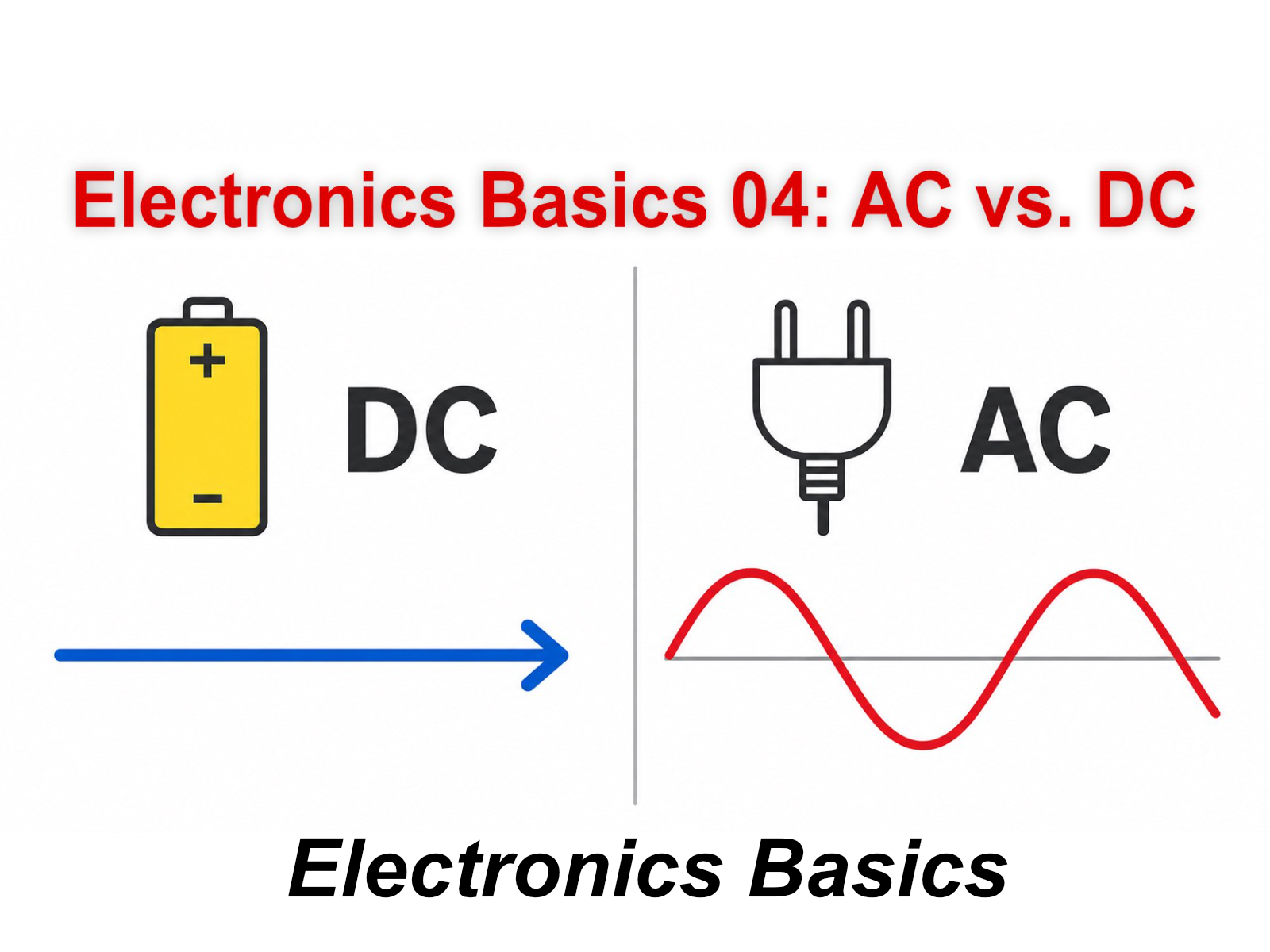
Welcome back to our Electronics Basics series. In the previous lesson, we explored voltage, current, and resistance. This lesson focuses on the two main forms of electric current you encounter every day: direct current (DC) and alternating current (AC).
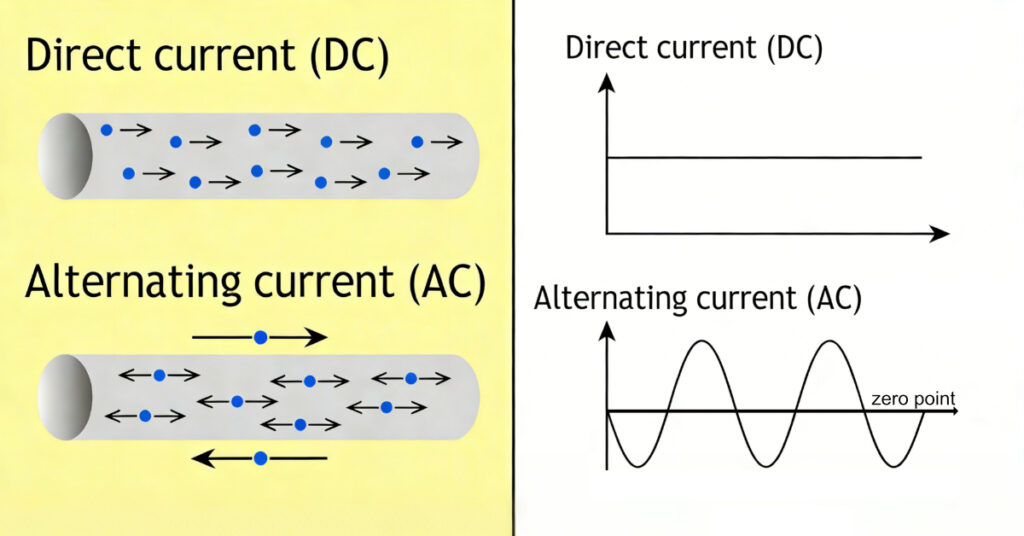
Their essential difference is direction. Conventional current in a DC circuit flows in one direction, while current in an AC circuit reverses direction periodically. In metal wires, electrons move in the direction opposite to conventional current.
1. What Is Direct Current (DC)?
Direct current (DC) has fixed polarity, and conventional current flows in one direction. A battery is the most familiar DC source: conventional current travels through the external circuit from the positive terminal toward the negative terminal, while electrons in the metal wire drift the opposite way.
DC does not have to be perfectly constant. Its voltage or current can rise, fall, pulse, or contain ripple while still remaining DC, provided its polarity does not periodically reverse. A battery supplies approximately steady DC, but its terminal voltage changes with charge level and load.
Common DC sources include:
- Batteries and battery packs
- Solar panels
- USB power supplies and phone chargers on their output side
- Rectifiers that convert AC into DC
Key Traits of DC
- Conventional current keeps the same direction.
- Polarity remains fixed.
- The magnitude may be constant or may vary over time.
- DC is widely used by electronic circuits, battery-powered products, vehicles, and data systems.
- Modern high-voltage direct current (HVDC) systems can transmit large amounts of power efficiently over long distances, especially through submarine cables and between asynchronous grids.
2. What Is Alternating Current (AC)?
Alternating current (AC) changes direction periodically. Its voltage also reverses polarity. Utility power is usually close to a sine wave, although AC can have other wave shapes, including square and triangular waves.
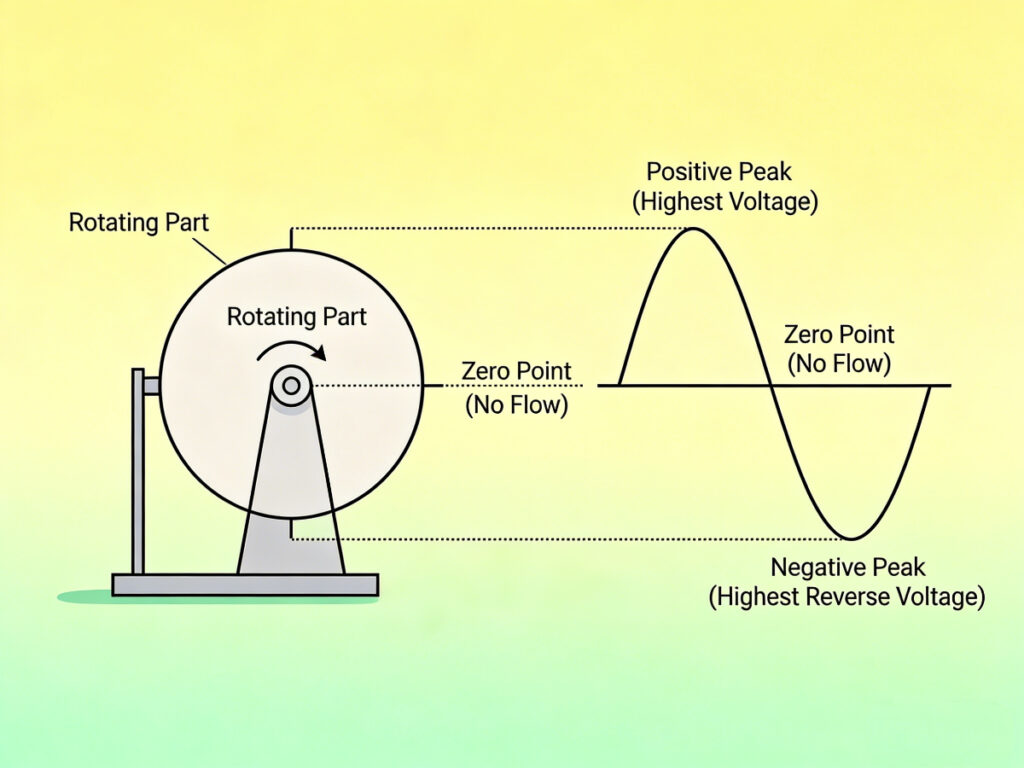
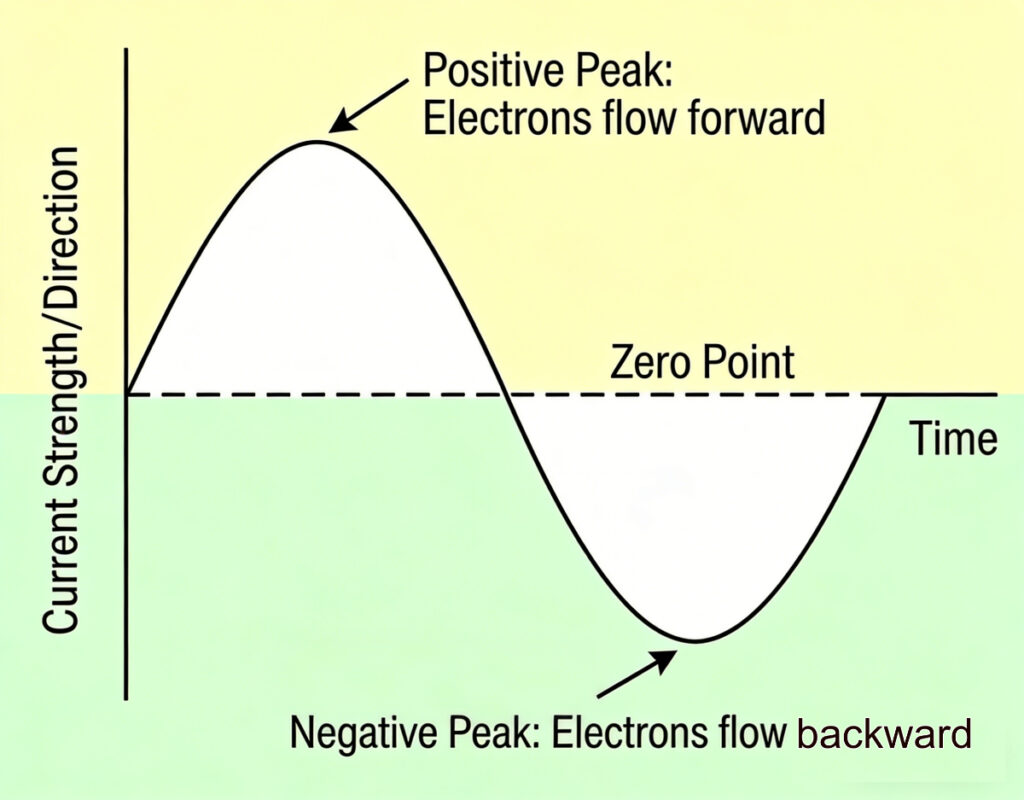
In a sine wave, the value rises to a positive peak, returns through zero, reaches a negative peak, and returns through zero again. One complete positive-and-negative pattern is one cycle.
How AC Is Generated
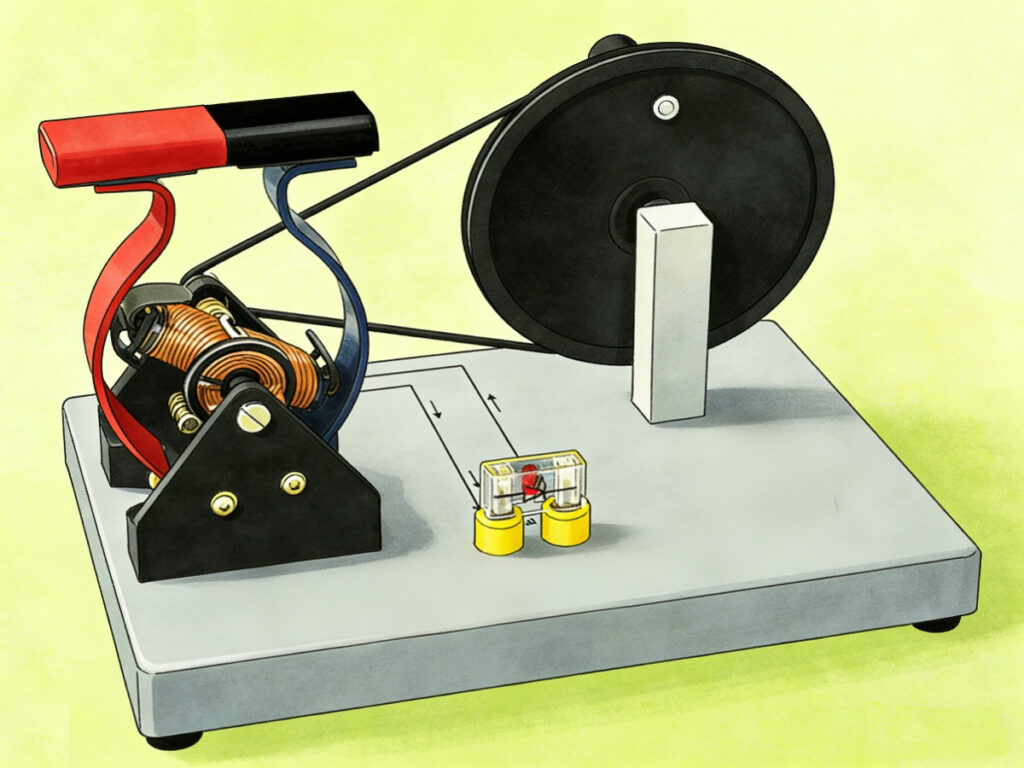
Power-station generators convert mechanical rotation into electrical energy through electromagnetic induction. As a coil or magnetic field rotates, the induced voltage changes polarity periodically. A simple generator can therefore produce a sine-like AC waveform.
The waveform below shows an idealized AC current in a simple resistive circuit. Values above zero represent one current direction; values below zero represent the opposite direction.
Frequency
Frequency tells us how many complete cycles occur each second. It is measured in hertz (Hz).
- At 50 Hz, the waveform completes 50 cycles per second.
- At 60 Hz, it completes 60 cycles per second.
Most power systems use either 50 Hz or 60 Hz, depending on the country or region. Generator speed and the number of magnetic poles together determine the electrical frequency; one electrical cycle does not always equal one mechanical rotation.
Why AC Is Used on Power Grids
AC voltage can be stepped up or down efficiently with transformers. Power grids raise voltage for transmission because sending the same power at a higher voltage requires less current, reducing resistive losses in the lines. Transformers then lower the voltage for regional distribution and local use.
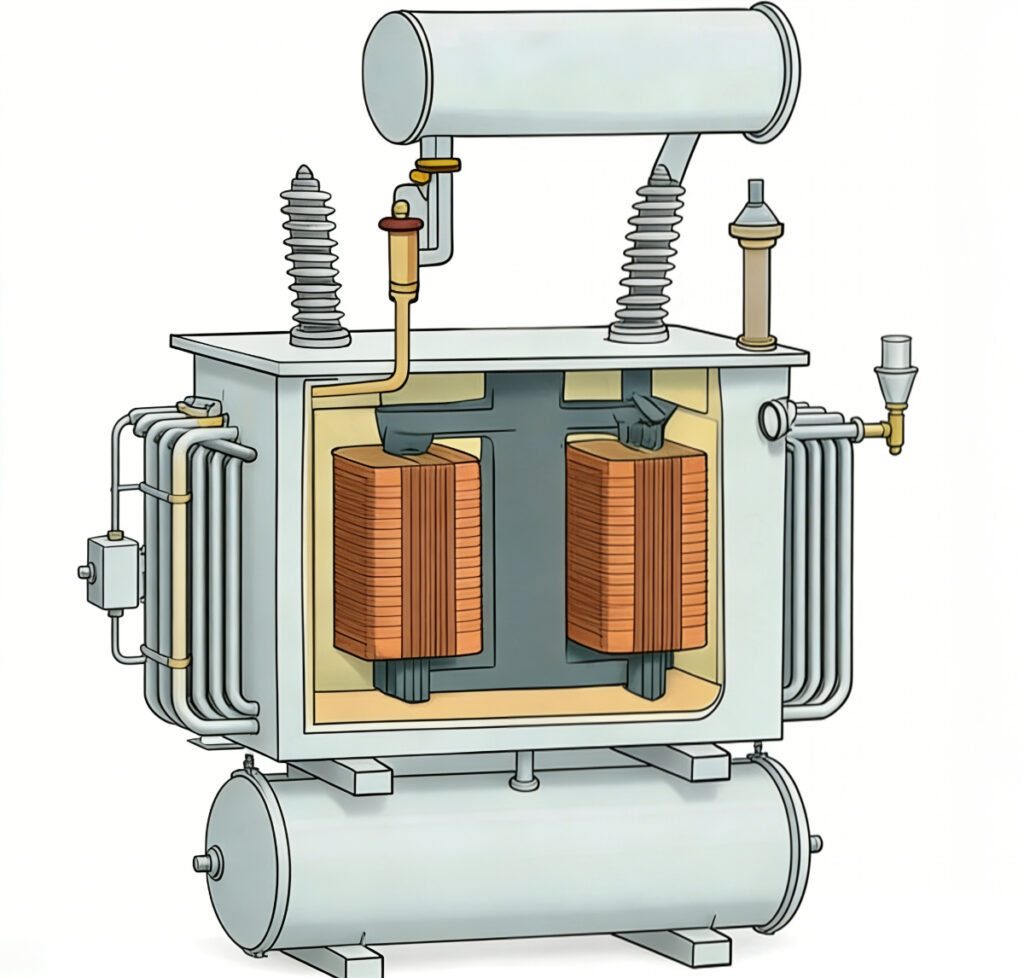
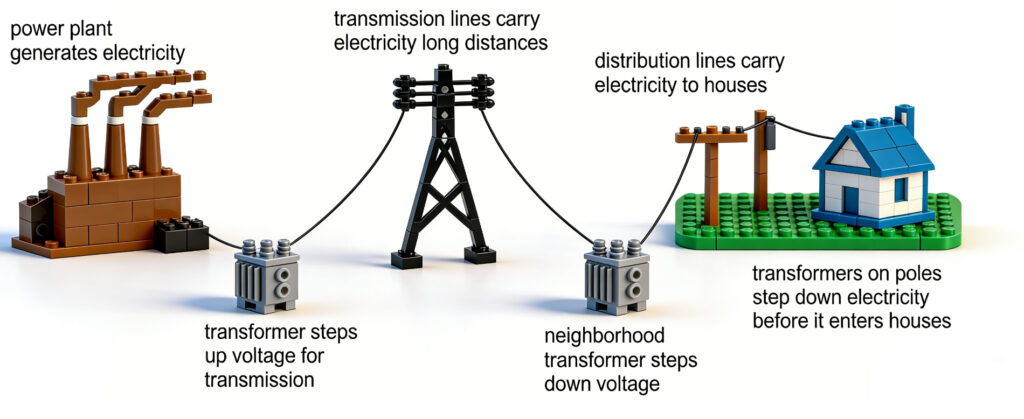
AC became the basis of most public grids because transformers made voltage conversion practical and efficient. This does not mean DC is unsuitable for transmission: modern HVDC links are valuable in several long-distance and cable applications, but they require electronic converter stations at their ends.
Key Traits of AC
- Current reverses direction and voltage reverses polarity periodically.
- Utility AC is normally close to a sine wave.
- Frequency is measured in hertz.
- Transformers can change AC voltage efficiently.
- AC is supplied by wall outlets and powers the wider electricity grid.
3. Core Differences Between AC and DC
| Characteristic | Direct Current (DC) | Alternating Current (AC) |
|---|---|---|
| Direction | One direction | Reverses periodically |
| Polarity | Fixed | Reverses periodically |
| Typical waveform | Constant level or varying level that does not reverse polarity | Sine, square, triangle, or another alternating waveform |
| Common sources | Batteries, solar panels, rectifiers, DC power supplies | Alternators, generators, inverters, wall outlets |
| Voltage conversion | Requires electronic converters for efficient step-up or step-down | Easily changed with transformers |
| Common uses | Electronic circuits, batteries, USB devices, vehicles, data systems | Utility grids, motors, heating appliances, household outlets |
| Long-distance transmission | Used in specialized HVDC links | Used throughout conventional transmission and distribution grids |
4. How to Identify AC and DC in Daily Life
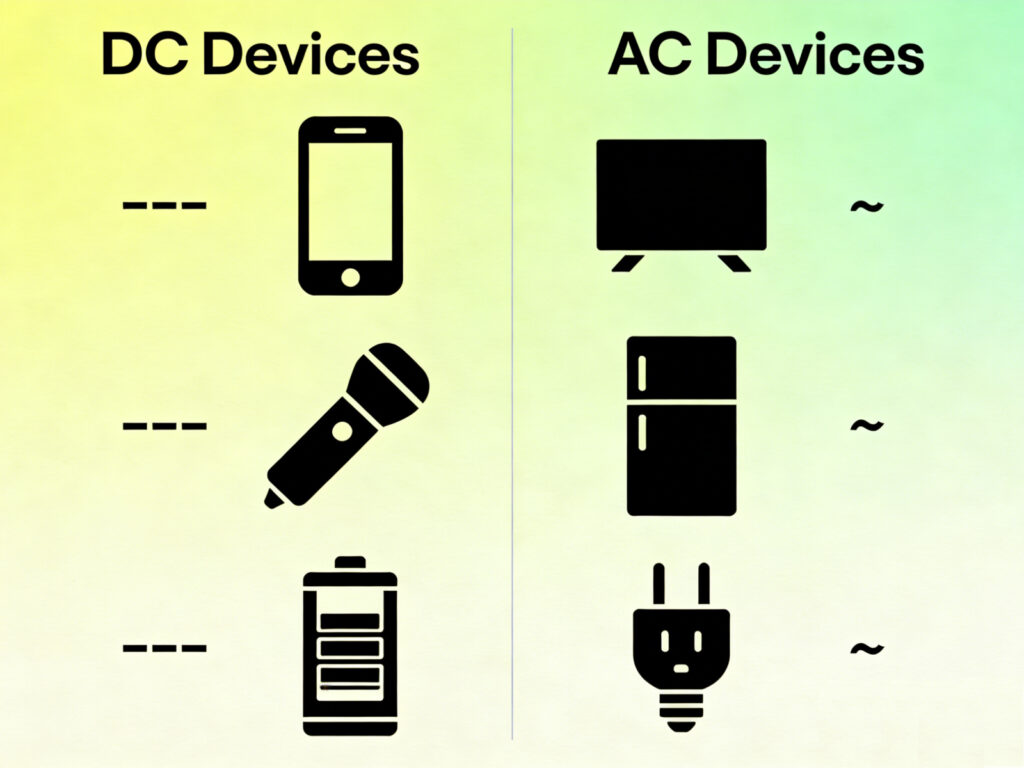
Method 1: Check the Power Source
- A device powered directly by a battery receives DC.
- A wall outlet supplies AC.
- A wall-powered electronic device may still operate internally on DC. Its adapter or internal power supply converts the incoming AC.
The power source is therefore a useful clue, but the label is more reliable than the device’s size or portability.
Method 2: Read the Label
Look for these markings on the product, adapter, or power supply:
- AC: a tilde or sine-wave symbol,
~ - DC: a solid line above a dashed line,
⎓ - Text: labels such as
AC INPUT,DC OUTPUT,12 V DC, or230 V AC
A phone charger is a familiar example: its input receives AC from the wall, and its output provides regulated DC to the phone.
Method 3: Do Not Rely on Appearance Alone
Portable products often use battery-supplied DC, and high-power appliances often connect directly to AC outlets. However, many products combine both forms. Laptops, televisions, LED lamps, and chargers accept AC at their input but convert it to DC for their electronic circuits.
Never open a device or touch exposed conductors to identify the supply. Use the printed label or documentation.
5. AC vs. DC Waveforms
Waveforms provide the clearest visual comparison. An ideal steady DC voltage appears as a horizontal line above zero. A typical utility AC voltage appears as a sine wave that crosses zero and alternates between positive and negative values.
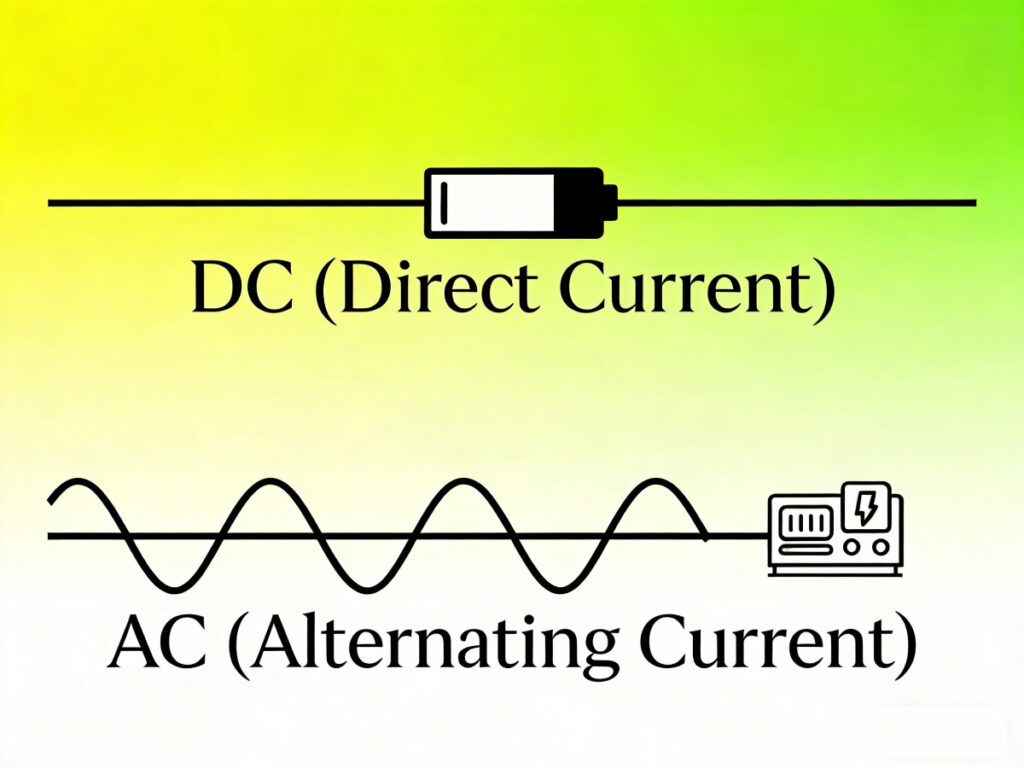
- DC waveform: remains on one side of zero, even if its magnitude changes.
- AC waveform: crosses zero and changes polarity periodically.
These waveform shapes may represent voltage or current. In circuits containing inductors or capacitors, voltage and current may not cross zero at the same instant because they can be out of phase.
6. Summary
- DC maintains one polarity and one conventional-current direction.
- AC reverses direction and polarity periodically.
- Batteries, solar panels, and electronic power-supply outputs commonly provide DC.
- Wall outlets and conventional public grids provide AC.
- A transformer changes AC voltage, while electronic converters are used to change or switch DC voltage.
- The most dependable way to identify AC or DC is to read the product’s electrical label.
Next in Electronics Basics, we will explore the basic components of a circuit—power source, load, and wires—and how they work together.