
Electronics Tools
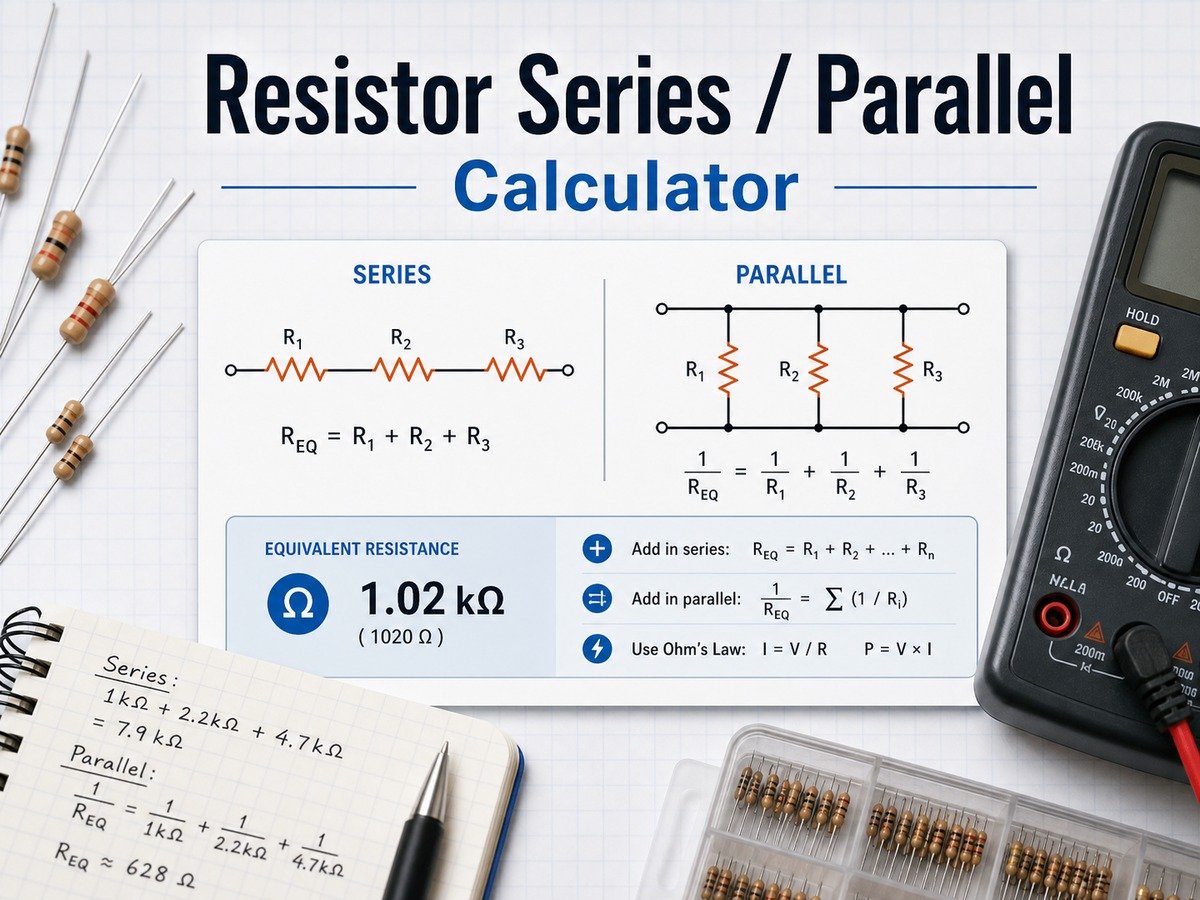
Resistor Series / Parallel Calculator
Calculate the equivalent resistance of two or more resistors connected in series or parallel. Add your resistor values, choose the connection type, and optionally enter a voltage to check current and power.
What this tool doesFinds the total equivalent resistance for common resistor networks.
Series ruleResistance values add directly, so the total is always larger.
Parallel ruleConductance values add, so the total is smaller than the smallest branch.
Calculator
Use two or more positive resistor values. Add up to 12 resistors.
Results
Equivalent resistance
—
—
Applied voltage
—
—
Total current
—
—
Total power
—
—
Per-resistor voltage, current, and power details appear here.
| Part | Resistance | Voltage | Current | Power | Share |
|---|
Formulas
Series resistors carry the same current. Parallel resistors share the same voltage and split current by branch resistance.
Series:
Rtotal = R1 + R2 + R3 + …
Parallel:
1 / Rtotal = 1 / R1 + 1 / R2 + 1 / R3 + …
With applied voltage:
I = V / Rtotal
P = V x I
Practical Notes
- In series, one open resistor breaks the whole path; in parallel, one open branch leaves the others connected.
- The equivalent value is only nominal. Real parts vary with tolerance, temperature, and power loading.
- Check each resistor’s power rating. Parallel branches can dissipate very different amounts of power.
- For precision dividers or sensor inputs, include resistor tolerance and the input impedance of the next stage.
How to Use
- Choose Series when resistors are connected end-to-end in one current path.
- Choose Parallel when both ends of every resistor connect to the same two nodes.
- Enter each resistor value and unit. Use the add and remove buttons to match your network.
- Enter an applied voltage if you want current and power estimates for each resistor.
Related Tool Ideas
- 220 Ω, 330 Ω, and 470 Ω in series give 1.02 kΩ.
- 1 kΩ, 2.2 kΩ, and 4.7 kΩ in parallel give about 599.8 Ω.