
Ham Radio Tools
SWR & Return Loss Calculator
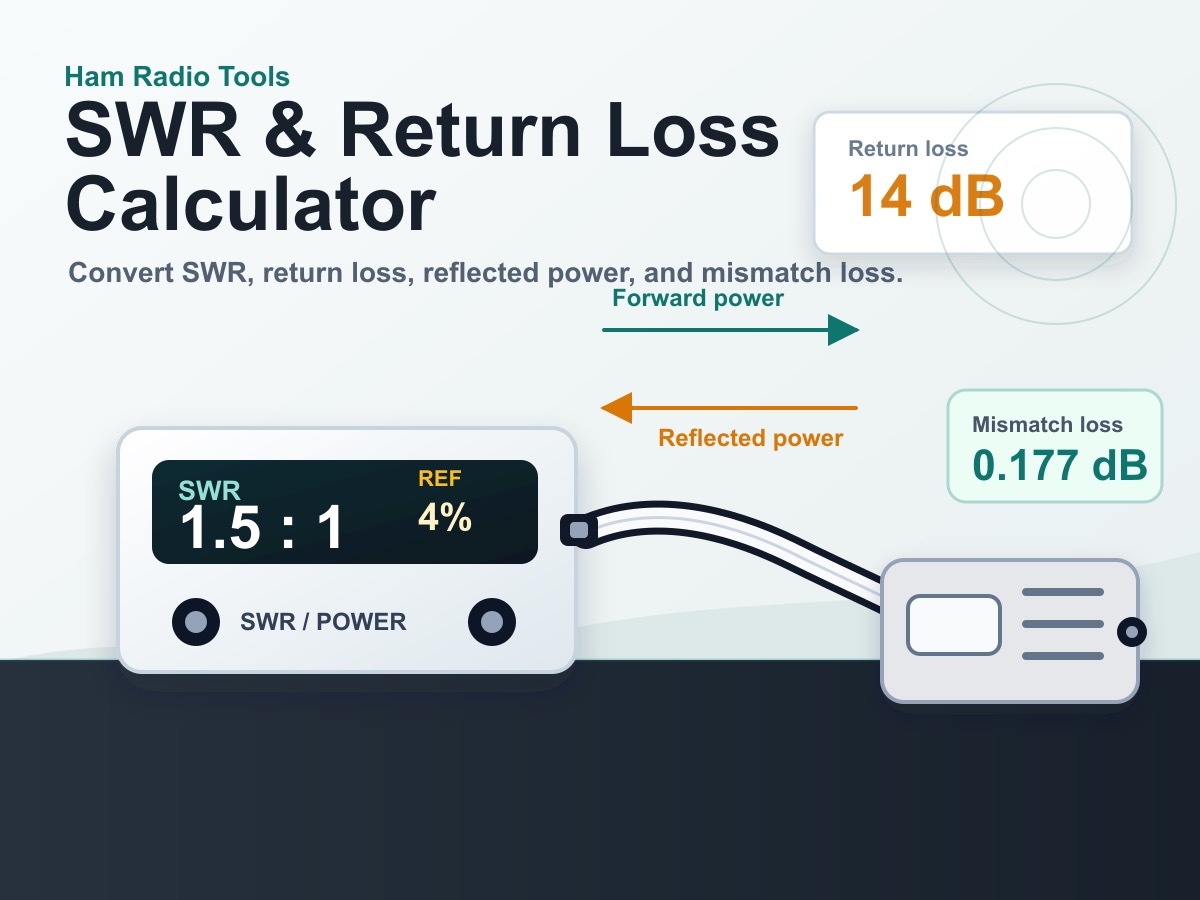
Convert between SWR, return loss, reflection coefficient, reflected power ratio, and mismatch loss. Add forward power when you want reflected watts and net power at the measurement point.
What this tool does
It converts mismatch measurements into the same set of practical RF quantities.
Power is optional
SWR or return loss alone gives ratios. Add forward power to get reflected watts.
Measurement point matters
Net power here means forward minus reflected power at the meter or analyzer location.
Calculator
Results
SWR
—: 1
—
Return loss
—dB
—
Reflection coefficient
—
Voltage-wave ratio, not power
Reflected power ratio
—%
—
Mismatch loss
—dB
Loss from mismatch only
Reflected power
—W
Requires forward power
Net power at meter
—W
Forward minus reflected power
Low mismatch
Results will appear as inputs change.
| SWR | Return loss | Reflected power | Mismatch loss |
|---|
Formulas
These conversions use the magnitude of the reflection coefficient, often written as gamma. Gamma is a voltage-wave ratio; reflected power is gamma squared.
|Gamma| = (SWR – 1) / (SWR + 1)
SWR = (1 + |Gamma|) / (1 – |Gamma|)
Return loss dB = -20 log10(|Gamma|)
Reflected power ratio = |Gamma|^2
Mismatch loss dB = -10 log10(1 – |Gamma|^2)
Practical Notes
- SWR and return loss describe mismatch at the point where the measurement is made.
- A reflection coefficient of 0.5 means 25 percent reflected power, because power follows |Gamma| squared.
- Forward and reflected watts from a meter give net power at that meter, not necessarily power at the antenna.
- Feedline loss can make shack-end SWR look better than the actual antenna feed-point mismatch.
- A tuner can make the radio happy, but it does not remove mismatch loss already happening in the feedline.
Input Arrangement
- Use SWR mode when your meter or analyzer already shows SWR.
- Use Power mode when you know forward and reflected watts.
- Use Return loss mode when you are reading VNA or lab-style measurements.